
Artikel: Moissanite vs Cubic Zirconia: What's Actually Different?
Moissanite vs Cubic Zirconia: What's Actually Different?

Moissanite vs Cubic Zirconia
The Honest Difference
Both sparkle, both cost a fraction of diamond, and the internet treats one as a hero and one as a punchline. The truth is more useful: two good stones, two different jobs.
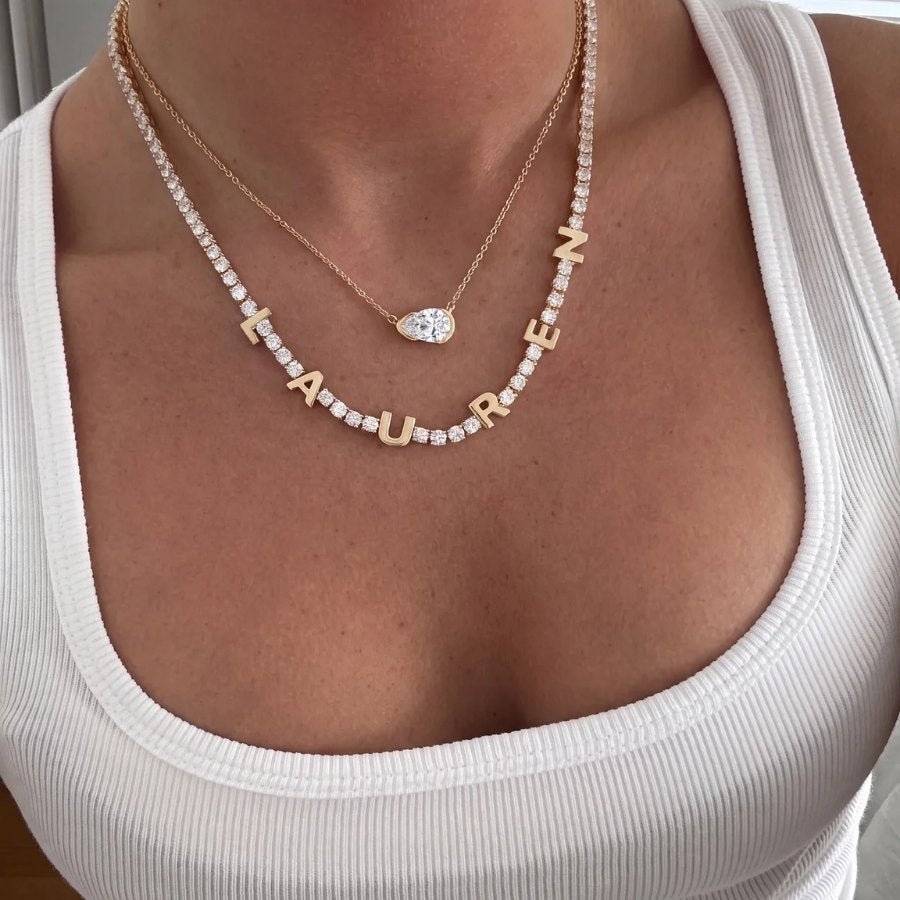
Here for the stones themselves? The moissanite line starts with the oval solitaire necklace is right here.
What Each Stone Actually Is
Strip the marketing and both stones are lab-made crystals with honest specifications.
Cubic zirconia (CZ) is crystallised zirconium dioxide: optically clear, inexpensive to produce, and the workhorse sparkle of modern fashion jewellery. It has carried the industry's white-stone looks for fifty years because it does the job beautifully at minimal cost.
Moissanite is silicon carbide, first identified in meteorite fragments and now grown in labs. It sits just below diamond on the hardness scale, above sapphire, and refracts light more strongly than diamond itself, the property behind its famous rainbow fire.
Neither is an imitation pretending otherwise; both are materials with data sheets. The question is never which is "real", both are real crystals, but which contract you need: seasons of sparkle at accessible prices, or decades of it at a premium worth understanding.
The Sparkle Test: Fire vs Flash
Side by side in daylight, the two stones sparkle differently, and knowing the difference lets you choose by taste rather than price alone.
Moissanite's higher refractive index and dispersion produce fire: rainbow flashes that outdance diamond in sunlight. It is the showier stone, visibly alive from across a room, which delights most wearers and reads as too much for a minority who prefer subtlety.
CZ produces clean white flash: bright, colourless sparkle closer to the classic diamond look at a glance. Fresh from the box, a well-cut CZ is genuinely beautiful, the style our tennis stone guide celebrates across the tennis category.
The practical eye test: moissanite announces itself in sunlight with colour; CZ stays icy white. Neither is wrong, they are different personalities of light, and the one you prefer is a legitimate deciding factor before any durability talk begins.

Hardness, Wear and the Decade Question
The structural difference between the stones is time, and it is measured on the Mohs scale.
Moissanite scores 9.25: harder than sapphire, second only to diamond among jewellery stones. In practice that means facet edges stay crisp and surfaces resist the micro-scratching that everyday life, dust, countertops, other jewellery, inflicts. A moissanite worn daily looks essentially unchanged after a decade, which is why it anchors engagement-adjacent pieces.
CZ scores around 8 to 8.5: hard, but soft enough that daily abrasion gradually rounds facet edges and clouds brilliance over years of constant wear. In occasional-wear pieces this barely matters; in a 24/7 daily ring it shows in time. CZ also carries slightly more density, and its optical clarity can dull as microscopic scratches accumulate, the familiar "my stone got quieter" of old fashion jewellery.
The honest framing: for pieces worn sometimes, the difference is academic. For the one stone you intend to wear every day for years, hardness is the specification that earns moissanite its premium. Settings matter too: claw-set stones in tarnish-free chains keep both stones brighter longer, because tarnish creeping around settings dulls more sparkle than scratches ever do.
Price, and What It Buys
The price gap between the stones is real, and it maps cleanly onto the jobs they do.
CZ jewellery in quality settings runs from the low tens of pounds: our CZ tennis and pendant pieces sit between £40 and £85 at the time of writing, sparkle for every day and every budget. Moissanite pieces occupy a different tier: the D-E colour graded stones in 925 sterling silver with 18k gold vermeil run £239 to £299 in the current line, solitaires built to the standards of the stone they carry.
| Cubic zirconia | Moissanite | |
|---|---|---|
| Material | Zirconium dioxide | Silicon carbide |
| Mohs hardness | 8 to 8.5 | 9.25 |
| Light signature | Clean white flash | Rainbow fire |
| Daily-wear ageing | Facets soften over years | Essentially unchanged |
| Typical Moonela setting | PVD steel, tennis and pendants | 925 silver, 18k gold vermeil solitaires |
| Price band (at writing) | £40 to £85 | £239 to £299 |
| The job | Everyday sparkle, statement volume | The forever stone below diamond money |
Note the setting difference, it is deliberate. CZ's price point suits the waterproof steel construction built for carefree volume; moissanite's permanence earns precious-metal settings that match its lifespan. Each stone gets the metal its contract deserves.

When to Choose Which
Choose CZ when the brief is coverage: tennis lines, stacked sparkle, trend pieces, gifts under £100, and any stone-set design you want in multiple colours or formats without a three-figure ticket per piece. Choose moissanite when the brief is one stone, worn always: the solitaire necklace that becomes your signature, the milestone gift meant to read as forever, the diamond look without diamond arithmetic. The two-stone wardrobe, CZ for breadth, one moissanite for depth, is quietly the smartest sparkle strategy in current jewellery.
The Diamond Question
Any stone comparison eventually faces the D-word, so here it is, briefly and without snobbery.
Diamond remains the hardness champion at Mohs 10 and the tradition champion at any dinner table. What it is not, since lab-grown supply reshaped the market, is the only credible forever stone. Moissanite delivers more fire, 90%+ of the hardness, and single-digit percentages of the mined-diamond price; a D-E graded moissanite solitaire reads flawless to every eye that has not brought a loupe to lunch. CZ, meanwhile, was never competing in that race: it is the stone that made sparkle democratic, and it keeps that title.
The honest hierarchy for 2026 buyers: diamond for tradition at tradition's price, moissanite for permanence at accessible-luxury money, CZ for beauty at everyday money. Three rungs, all legitimate, and the wardrobe that mixes rungs, per the pieces' jobs, beats any purist ladder. Deeper gemstone context lives in the birthstone guide.
Cuts and Shapes: Where Each Stone Shines
Stone chemistry sets the ceiling; the cut decides how much of it you see.
Moissanite's fire rewards cuts with large open facets: oval stretches light into long rainbow ribbons and flatters necklines, the logic of the oval solitaire; teardrop adds direction and reads romantic; emerald cuts trade fire for glassy elegance, showing the stone's clarity in broad flashes; round brilliant maximises total light return and reads most diamond-traditional. In a stone with this much dispersion, even modest sizes perform, one reason well-cut moissanite solitaires under a carat-equivalent read richer than their dimensions.
CZ's white flash suits repetition and geometry: uniform rounds in tennis lines, baguettes in deco-style rows, mixed-cut clusters where the pattern, not the individual stone, is the star. It also takes colour beautifully, the whole birthstone spectrum runs on colour-matched CZ, from January garnet-red to December zircon-blue, which moissanite's premium rarely justifies. Shape strategy in one line: buy moissanite for one stone's performance, CZ for many stones' choreography.
Caring for Each Stone, Realistically
Both stones outlive their settings' care needs, but two habits keep each at its best.
For CZ: the enemy is film, not damage. Sunscreen, lotion and skin oils mute white flash faster than scratches ever will, so the routine is a warm-water rinse and soft brush around settings whenever sparkle dims, thirty seconds, monthly-ish. In waterproof steel settings the whole piece can go under the tap without ceremony.
For moissanite: the same film logic applies, with one addition: its fire makes dullness more visible, so it rewards slightly more frequent rinses. The vermeil setting sets the boundary, treat the gold layer gently (no abrasives, minimise chlorine soaks) and the stone will outlast several replatings' worth of years. Neither stone needs professional cleaning, ultrasonic machines or storage rituals; both need only the one universal rule from our care guide: abrasion is the only enemy that leaves marks.
Gifting Stones: Reading the Occasion
The two stones split the gifting calendar as cleanly as they split the specification sheet.
CZ occasions: birthdays, Christmas, thank-yous, the volume calendar, where £40 to £85 buys generous sparkle and birthstone colour adds personal meaning without premium pricing. A CZ tennis bracelet or birthstone pendant is a complete, confident gift with no asterisks.
Moissanite occasions: the milestone tier, significant anniversaries, graduations that end eras, the promise-adjacent gifts where permanence is the message. The stone's decades-crisp hardness makes the metaphor literal, and D-E grading means the recipient's sharpest-eyed friend finds nothing to whisper about. It is the strongest forever-signal available below diamond spending, and the anniversary guide deploys it exactly there.
The mixed strategy for long relationships: CZ pieces mark the years, one moissanite marks the decade. Meaning scales better than carats.
Lab-Grown Diamonds: The New Neighbour
No 2026 stone comparison is complete without the disruptor reshaping the ladder above both stones.
Lab-grown diamonds, chemically identical to mined, at steep and still-falling discounts, have compressed the forever-stone market from above: real diamond hardness and prestige now starts where premium moissanite pricing used to sit. The effect on this comparison is clarifying rather than threatening. CZ's territory is untouched: nothing lab-grown approaches sparkle-per-pound for everyday volume. Moissanite's case sharpens to its genuine advantages: more fire than any diamond, grown or mined, at prices still meaningfully below lab-grown equivalents, and free of the is-it-real conversation entirely, moissanite competes as itself.
The 2026 ladder, then, reads: CZ for beauty at everyday money, moissanite for fire and permanence at accessible-luxury money, lab-grown diamond for tradition's letter at new-tradition prices, mined diamond for provenance romance at full fare. Four honest rungs; the wardrobe strategy of this guide, breadth low, one depth piece higher, survives the new neighbour intact.
Settings: Where Stones Live or Die
Buyers compare stones for weeks and settings for seconds, backwards, since settings cause most sparkle loss.
Claw settings maximise light entry and are this catalogue's default for both stones: more sparkle, with the trade of catching on knits occasionally. Bezel settings trade a little brilliance for total security and snag-proofing, the practical choice for stones on active hands. Pavé fields multiply small stones into surface fire and depend utterly on the base metal's stability, tarnish creeping around pavé is what kills cheap sparkle jewellery, which returns us to the series' refrain: the chain and setting metal decide the stone's visible lifespan as much as the stone itself. A perfect stone in reactive metal dulls by association; either stone in tarnish-free construction performs to its specification for its whole life.
The Sixty-Second Stone Glossary
The listing-page terms that actually matter, translated.
D-E colour: the top of the diamond colour scale, icy colourless, the grading our moissanite carries. Brilliance: white light returned; fire: coloured light dispersed, moissanite's signature. Mohs: scratch-hardness scale where daily-wear stones want 8+. Carat-equivalent: moissanite is lighter than diamond, so honest sellers size by millimetres, not carats. Colour-matched CZ: zirconia tinted to birthstone shades, the mechanism behind every affordable birthstone piece. Any listing using these terms precisely is a listing you can trust; any listing calling a stone "diamond-like" without one specification is telling you something too.
The Key Takeaways
The whole comparison in five lines.
- Both are real lab-made crystals: CZ is zirconium dioxide, moissanite is silicon carbide, neither is a fake with a costume.
- Light differs by personality: moissanite throws rainbow fire, CZ throws clean white flash, taste decides.
- Time is the real gap: Mohs 9.25 keeps moissanite crisp for decades; CZ softens gently under daily years.
- Price maps to job: CZ £40 to £85 for sparkle coverage, moissanite £239+ for the one forever stone.
- The smart wardrobe holds both: CZ breadth, moissanite depth, diamond optional.
Frequently Asked Questions
Is moissanite better than cubic zirconia?
Harder and more permanent, yes: Mohs 9.25 versus 8 to 8.5, with fire exceeding diamond. Better depends on the job: CZ delivers beautiful sparkle at a fraction of the price for everyday and statement pieces.
Can you tell moissanite from CZ by eye?
In strong light, often: moissanite flashes rainbow fire, CZ stays white. Between moissanite and diamond, casual eyes generally cannot tell.
Does cubic zirconia get cloudy?
Over years of daily wear, micro-scratches can soften its brilliance, in occasional wear it stays bright far longer. Moissanite resists this almost entirely.
Is moissanite worth the extra money?
For a single stone worn constantly, a signature solitaire, a milestone gift, yes: the hardness premium buys decades. For volume sparkle and trend pieces, CZ is the smarter spend.
What does D-E colour mean on moissanite?
The diamond colour scale's top grades: colourless. D-E moissanite reads icy white with no warm tint, matching the look of top-grade diamonds.
Are Moonela's stones moissanite or CZ?
Both, by line: the everyday and tennis collections use colour-matched CZ in waterproof PVD steel; the solitaire line uses D-E moissanite in 925 sterling silver with 18k gold vermeil.
Can you shower with moissanite and CZ jewellery?
The stones themselves ignore water. The setting decides: PVD steel pieces are built for daily showers; vermeil solitaires prefer gentler routines to protect the gold layer.
Is moissanite a fake diamond?
No, it is its own gemstone, silicon carbide, with properties that differ from diamond (more fire, marginally less hardness). It imitates nothing; it competes.
Which is better for an engagement-style ring?
Moissanite, structurally: daily-forever wear is exactly what Mohs 9.25 exists for. CZ engagement pieces are honest placeholders, not decade companions.
Do moissanite and CZ pieces hold value?
Neither is an investment vehicle, buy both for wear, not resale. Moissanite holds its beauty for decades, which is the only appreciation jewellery reliably offers.
Choose the Light You'll Live With
CZ sparkle for every day, D-E moissanite solitaires in 925 silver and 18k vermeil for the piece that reads forever.
Meet the Moissanite LineEveryday sparkle first? Browse tennis jewellery.